When businesses decide to invest in paid advertising, the first big question is almost always the same:
Should we spend on Google Ads or Meta Ads?
Both platforms can generate growth. Both can also waste budget if used incorrectly. The difference is not the platform itself—it’s how well the channel matches your business model, offer, and stage of growth.
This article explains the real difference between Google Ads and Meta Ads, when each one works best, and how growth-driven brands use them to scale revenue efficiently.
The Fundamental Difference: Intent vs Discovery
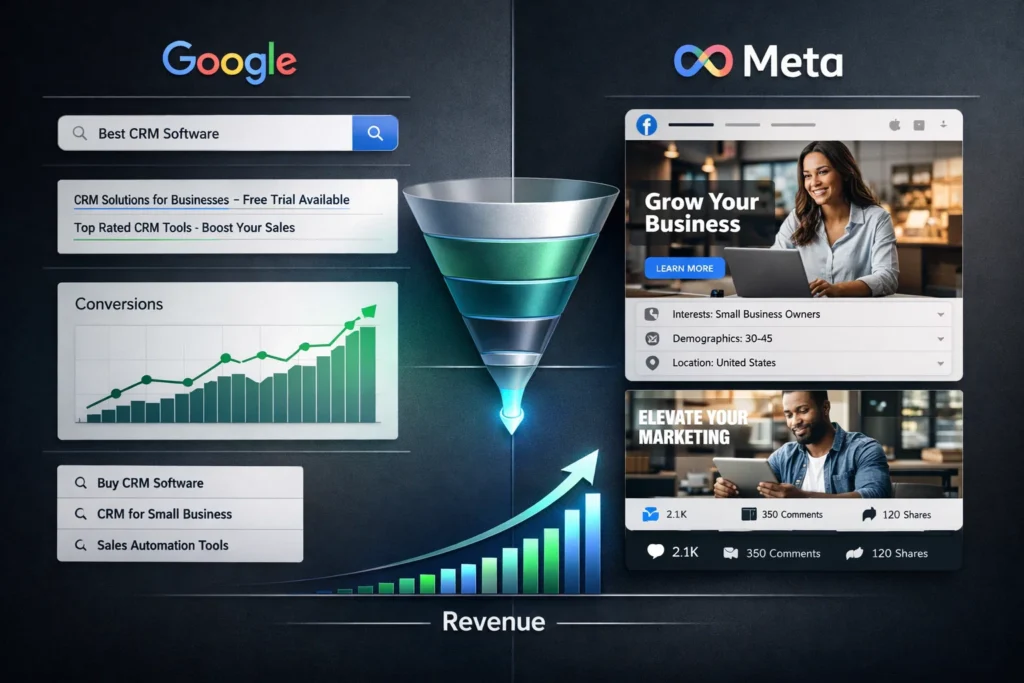
The core distinction between Google Ads and Meta Ads comes down to user intent.
- Google Ads captures demand.
People are actively searching for a solution. They already have a problem and want an answer. - Meta Ads creates demand.
People are scrolling. They are not searching for a solution, but they can be influenced, educated, and persuaded.
Understanding this difference alone prevents most budget waste.
Google Ads: High-Intent Traffic That Converts Faster
Google Ads places your business in front of users who are already looking for what you offer. This makes it one of the most efficient channels for direct response and lead generation.
When Google Ads Works Best
- Service-based businesses
- B2B and SaaS companies
- High-ticket offers
- Local businesses
- Businesses with clear problem–solution messaging
If someone searches for “performance marketing agency,” “CRM software for startups,” or “emergency AC repair,” they are close to making a decision. Google Ads intercepts that intent.
Strengths of Google Ads
- Strong buying intent
- Predictable lead quality
- Easier ROI measurement
- Faster path to revenue
- Works well with optimized landing pages
Common Google Ads Mistakes
- Targeting broad, low-intent keywords
- Sending traffic to generic homepages
- Ignoring conversion rate optimization
- Scaling budget before proving profitability
When Google Ads is paired with strong landing pages and clear offers, it often delivers the fastest return on ad spend.
Meta Ads: Demand Creation and Scalable Awareness
Meta Ads (Facebook and Instagram) operate differently. Users are not searching for solutions—they are discovering them.
This makes Meta Ads incredibly powerful for brands that understand creative, messaging, and audience psychology.
When Meta Ads Works Best
- E-commerce brands
- Consumer products
- Subscription-based offers
- Lifestyle and visual brands
- Businesses focused on long-term scale
Meta Ads excels at storytelling, audience testing, and building familiarity before conversion happens.
Strengths of Meta Ads
- Advanced audience targeting
- Lower cost per impression
- Excellent retargeting capabilities
- Strong creative testing environment
- Scales awareness efficiently
Common Meta Ads Mistakes
- Expecting immediate sales from cold audiences
- Weak creatives without a clear hook
- Poor audience segmentation
- No retargeting or funnel depth
- Optimizing for clicks instead of conversions
Meta Ads rewards patience, testing, and iteration. Brands that focus only on short-term sales usually underperform.
Google Ads vs Meta Ads: Side-by-Side Comparison
User Intent
Google Ads: High
Meta Ads: Low to medium
Speed to Revenue
Google Ads: Faster
Meta Ads: Slower initially
Creative Importance
Google Ads: Moderate
Meta Ads: Critical
Best Use Case
Google Ads: Capturing existing demand
Meta Ads: Creating and scaling demand
Scalability
Google Ads: Scales with proven funnels
Meta Ads: Scales with strong creatives and audiences
Which Platform Scales Faster?
There is no universal winner. The faster-scaling platform depends on your business context.
- If people are actively searching for your solution, Google Ads usually scales faster.
- If your product requires education, awareness, or emotional connection, Meta Ads often wins long-term.
High-performing brands rarely rely on just one channel.
The Smart Growth Strategy: Use Both
The most successful brands combine both platforms into one unified growth system.
A common approach:
- Meta Ads build awareness and warm audiences
- Google Ads capture high-intent searches
- Retargeting connects both channels
- Conversion optimization maximizes value from every visitor
This structure turns advertising into a predictable revenue engine instead of isolated campaigns.
How to Decide Where to Start
Ask the right questions before choosing a platform:
- Are people actively searching for my solution?
- Can I track conversions and revenue accurately?
- Is my offer already validated?
- Is my website optimized to convert?
If the answer is yes, Google Ads is often the best starting point.
If not, Meta Ads can lay the foundation for future scale.
Final Thoughts
Google Ads and Meta Ads are not rivals. They are tools designed for different stages of the buyer journey.
The real mistake is not choosing the wrong platform—it’s choosing without strategy.
When paid advertising is aligned with intent, creative, and conversion optimization, scaling becomes controlled, measurable, and profitable.
If your goal is faster growth, the right question isn’t Google Ads or Meta Ads?
It’s Which platform fits my business right now, and how do I scale it intelligently?